Songyan Power Founder Jiang Zheyuan: 2026 Is the Year of Mass Delivery, Targeting 10,000 Units
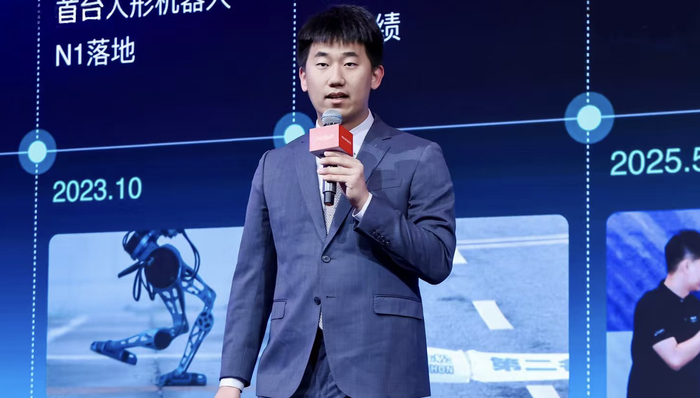
Shanghai — Songyan Power, the humanoid robot startup featured on this blog on March 6, is now making good on its production promises. At AWE 2026 in Shanghai, founder and chairman Jiang Zheyuan officially delivered the first batch of “Xiaobumi” robots to customers, while outlining an ambitious goal for the year: deliver at least 10,000 units in 2026.
“Last year, the global humanoid robot industry delivered just over 10,000 units in total. If a single company can achieve 10,000 deliveries this year, it means the industry is growing at several times the scale year-over-year,” Jiang said in an interview with Interface News and other media outlets.
From Spring Festival Gala Spotlight to JD.com’s Bestseller
The post-Spring Festival Gala effect has translated directly into sales. According to Jiang, since appearing on the 2026 CCTV Spring Festival Gala, Songyan Power quickly became the number one seller in JD.com’s humanoid robot category, with orders growing several times compared to before the holiday.
However, Jiang cautioned against overestimating the impact of media exposure on fundraising. “No one will invest in you just because you were on CCTV and became famous. That’s not how it works. Whether interest translates into actual investment decisions ultimately depends on the company’s fundamentals,” he told a local media outlet.
The Challenge of Scaling: Supply Chain and Factory Management
For Jiang, 2026 is defined by one word: delivery. “We don’t have plans to release new products in the near future. This year, our main focus is on delivering existing products well,” he stated.
The path to 10,000 units is fraught with operational challenges that rarely make it into demo videos. Jiang shared candid insights into the realities of mass production:
- Supply chain fragility: A humanoid robot contains hundreds or even thousands of different components. “If just one material is out of stock, the entire production line stops,” Jiang explained. To mitigate this, Songyan has invested in building both pre- and post-inventory systems, stocking up on key components even before price increases.
- Workforce management at scale: When monthly production reaches the thousands, managing a large assembly team becomes a major challenge. “I’ve seen workers take a hammer to forcefully screw in bolts that wouldn’t fit,” Jiang recounted, illustrating the kinds of problems that emerge when scaling up rapidly.
- Cost control through materials: One of the key reasons “Xiaobumi” can be priced at just 9,998 yuan ($1,380) is its use of composite materials rather than metal. “Not using metal for the robot body was probably the most successful decision we made,” Jiang said.
No Absolute Moats, Only Time Advantages
When asked about Songyan’s core competitive advantage, Jiang offered a sobering view of the industry: “I don’t think any technology today has an absolute moat. Through open source and talent acquisition, all technology can be equalized. The so-called moat is just a time difference.”
What matters, he argues, is staying ahead in supply chain management, mass production capabilities, and ecological interaction—and maintaining that time difference long enough to build a real barrier.
The Data Flywheel: Not There Yet, But Coming
Can a robot priced under $2,000 generate the data needed to train next-generation models? Jiang’s answer is honest: “Currently, the answer is no, but soon it will be.”
The current generation of products lacks the capability for complex household operations. However, as costs decline and technology advances, Jiang envisions designing “data collection games” that users would willingly participate in—provided the robots are already in their homes.
Industry Outlook: 2026 Is the Year of Accountability
Jiang predicts that 2026 will see intensifying polarization in the embodied AI sector. “If a company can achieve 10,000-unit delivery this year, or make a breakthrough in ‘brain’ technology, it will accelerate this polarization. This is the year the industry keeps handing in its exam papers,” he told a media outlet.
As for the industry bubble debate, Jiang offered a measured perspective: “The definition of a bubble depends on the gap between expectations and reality. If the extremely high expectations—’car prices, phone volumes’—ultimately cannot be realized, then there is a big bubble today. But if those expectations are actually met, then there’s no bubble. Right now, it seems achievable.”
My take
When I wrote about Songyan Power’s funding round on March 6, the story was about capital and ambition. Standing at AWE 2026, just days later, the story has shifted to execution and delivery. Jiang’s interview reveals a founder unusually grounded in operational reality—worried about screwdrivers and supply chains, not just demos and valuation.
The “10,000 units” target matters. Last year’s global total was just over 10,000. If Songyan hits that number alone, it means the industry has crossed a threshold from laboratory curiosities to actual products. And Jiang’s honesty about the challenges—workers with hammers, missing components, the limits of current data collection—is exactly the kind of transparency that builds long-term credibility.
The race is no longer about who has the flashiest backflip. It’s about who can ship 10,000 units, collect real-world data, and survive the “year of accountability.” Songyan is placing its bet on supply chain and production breakthroughs. We’ll watch to see if it pays off.
Tags: Songyan Power, Jiang Zheyuan, Xiaobumi, Mass Production, Humanoid Robots, AWE2026, Supply Chain, China Robotics
Category: News